Where the Milky Way Meets the Lake: Dark-Sky Nights on Freshwater Islands
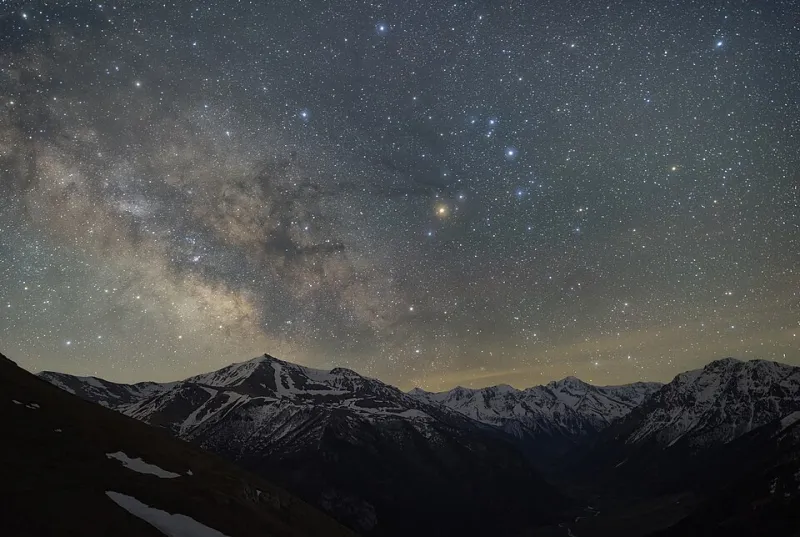
Photo: Alexander Kurilov, CC BY 4.0, via Wikimedia Commons
The best part of night on a freshwater island is not the stars. It is the moment just before them. The ferry engine fades. The day-trippers' coolers stop clanking. The dock lights—if there are any—click off or shrink to red pinpricks. Then the lake starts doing that thing where it holds the sky like a second, shakier version of itself. If you are lucky, and the clouds cooperate, the Milky Way comes out not as a postcard but as a texture: dust, light, and distance pressing down on the water.
Why Freshwater Islands Go Dark
Islands are not automatically dark. A single unshielded security light at a marina can ruin a whole cove. But islands often have an advantage: fewer roads, fewer strip malls, fewer porch lights left on for no reason. Their darkness is less an accident than a kind of infrastructure. When it is intact, it is an ecosystem service.
That matters because light pollution is not just a problem for photographers. Artificial light at night pulls insects away from wetlands, which pulls bats and birds into the wrong places. It disorients migrating birds, especially on foggy nights over big water. It can change the behavior of fish, turtles, and amphibians. On an island, where habitat is already finite, a bright dock can be a bigger deal than it looks.
DarkSky International certifies parks and communities that meet specific lighting standards. Isle Royale National Park in Michigan is an International Dark Sky Park, and several other freshwater island areas have exceptional skies even without a certificate. The point is not the plaque. The point is the policy—shielded fixtures, warmer bulbs, motion sensors, and a willingness to turn things off.
Four Island Nightscapes Worth Planning Around
Isle Royale National Park, Michigan. This is the classic: a roadless island in Lake Superior, reached by ferry or seaplane, with campgrounds at Rock Harbor and Windigo and backcountry sites that require permits. The darkness is deep, the horizon is wide, and the lake makes its own weather. Go prepared for cold and wind, even in summer.
Apostle Islands National Lakeshore, Wisconsin. Camping on islands such as Stockton and Sand puts you under some of the darkest skies in the Upper Midwest. You will still see the glow of Bayfield and Ashland on the horizon, but overhead the sky opens up. Permits are required, and campfires are restricted in places, so check the rules before you pack the marshmallows.
Grand Island National Recreation Area, Michigan. Just north of Munising, Grand Island is a ferry ride and a world away from the lights of town. Rustic campsites, Lake Superior shoreline, and a sky that rewards a tripod. The island is popular with day visitors, but the night crowd is small.
Boundary Waters Canoe Area Wilderness, Minnesota. This is not a single island, but the wilderness is full of lake islands, and the roadless darkness is some of the best in the eastern United States. You need a permit and real paddling skills. What you get back is a sky so crowded with stars that navigation apps feel like cheating.
How to Photograph the Night Without Wrecking It
Start with the moon. A new moon is darkest, but a thin crescent setting early can be beautiful. Check the phase, the weather, and smoke forecasts. Smoke from wildfires can turn a clear sky into a brown haze, which is bad for stars and bad for your lungs.
Bring a tripod, a wide-angle lens, and a headlamp with a red-light mode. Learn to focus manually at infinity in daylight, then tape the focus ring if you are clumsy. Start with ISO 3200, an aperture around f/2.8, and a 15- to 20-second exposure. If the stars trail, shorten the exposure. If the image is too dark, raise ISO before you lengthen the exposure into mush.
And please: no white floodlights, no flash, no drones at night. Other people are out there for the quiet. If you want star trails, find a composition that does not require you to light up a historic structure or a nesting beach. The best night photos are usually the ones that leave the place exactly as they found it.
Camping After Dark Without Leaving a Mark
Arrive before sunset. Setting up a tent by headlamp is how people trample rare plants and lose their stakes. Cook and clean before dark, and store food properly—island raccoons, foxes, and birds are smart. Use existing fire rings only where fires are allowed, and keep them small. Better yet, skip the fire and let the stars be the show.
Keep your light low and pointed down. Red light preserves night vision and is less disruptive to wildlife. Do not shine lights into trees, nests, or the water. If you are camping near shore, give the shoreline a buffer. Frogs, turtles, and foraging mammals use that edge at night.
Pack out everything, including glow sticks, tea bags, and bits of foil. Leave No Trace after dark is the same as Leave No Trace in daylight—just harder to see. A final sweep with a red headlamp before you leave camp will catch what your morning brain missed.
The Case for Turning Off the Dock Light
Island darkness is not a luxury. It is part of what makes a freshwater island different from a mainland resort. It is also something we can protect with boring, practical choices: shielded fixtures, timers, motion sensors, and a culture that treats dark skies as a shared resource rather than an inconvenience.
So when the last boat leaves, do not rush to fill the quiet with light. Let your eyes adjust. Let the lake go black and silver. Let the Milky Way be the main event. The island has been waiting all day for this.